
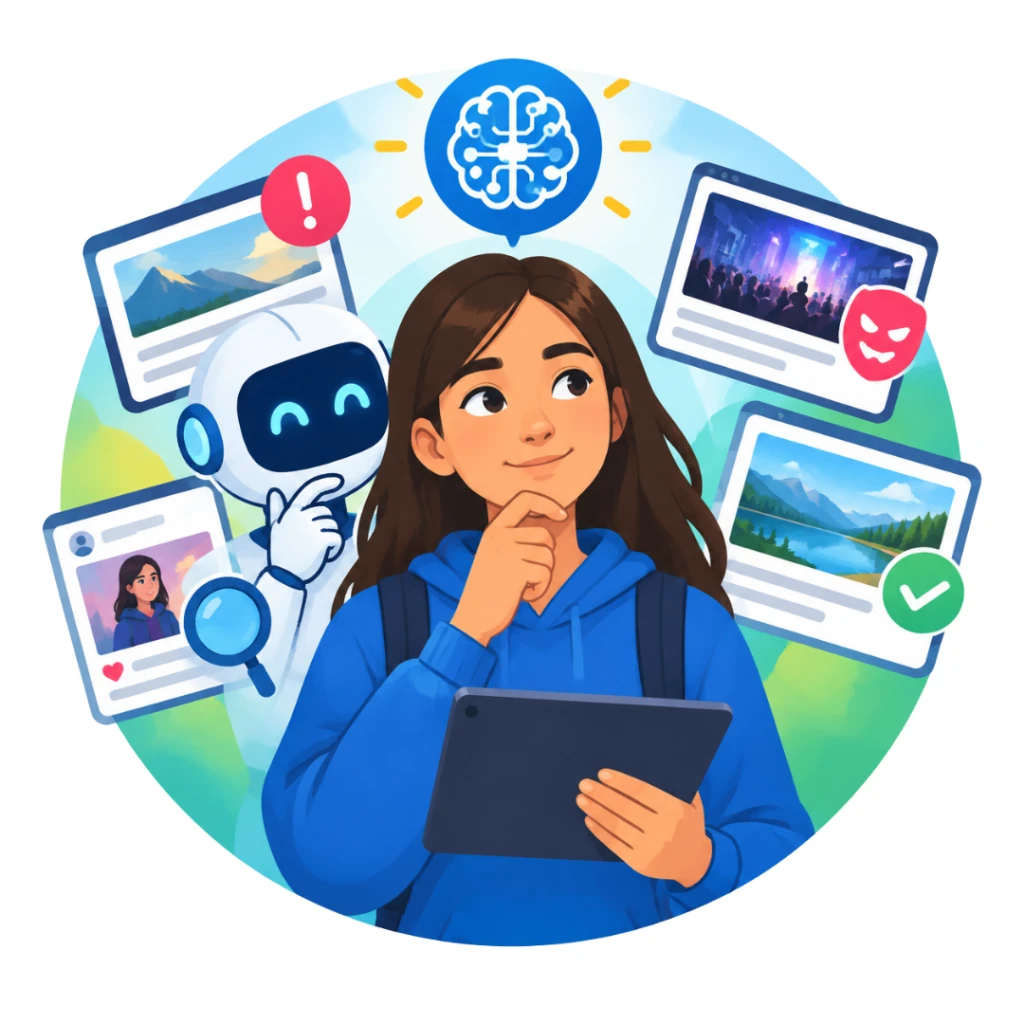
It seems that all anyone can talk about today is Artificial Intelligence. Whether someone believes it’s a tool to help or if it’s something that exists to hinder or take away, it exists. We live in a world where teens are growing up with excessive access to online tools and social media. As guardians, caregivers, and educators – it’s important to know what teens are up against to give them all the tools they need to succeed in this world. Let’s talk about it.
Is getting the quick answer worth it?
In classrooms, as educators, we hear a lot of questions from kids when we start to talk about media literacy and accurate sources of information. The first thing students ask is always “Can I just google it? Wouldn’t that work?”. It seems like the easy, “quick way” to get answers to their questions that they might be too uncomfortable to ask a trusted adult about. Nowadays, the first thing that pops up when a question is googled is an “AI overview”. How does a teen know whether that curated answer is peer reviewed? How can someone tell whether it is accurate or not? That all comes down to media literacy.
Media Literacy
Media literacy is a large part of what we do as educators because teens need to know how to find true and verifiable information. Here are some key takeaways to make sure that you understand what it means to be media literate:
- Evaluate your Sources – Is this an opinions-based piece, or is this a facts-based article?
- Recognize Bias – Why was this article created? Is anyone benefiting from the answer?
- The Answer is Supported – Can I find this same answer on different sources?
What We Know
The best answer to a question about sexual health is the answer that you can get from a trusted source. Whether that’s a teacher, a nurse, a doctor, an educator, or a parent – those are the sources to turn to. Sure, AI may be able to give an answer. But will the answer be culturally responsive? Will the answer be age appropriate? Will the answer actually get to the bottom of the question? The answer to those questions is most likely, no. AI works as a tool to help guide or a tool to streamline productivity, it is not meant to be a tool to educate teens, especially when it comes to sexual health.
How can we help?
As a trusted adult of a young person, make sure that you are talking regularly about the use of AI and what its limits are. AI is not a magical “fix it” tool. It has limitations, and one of those limitations is in making sure that those important questions about sexual health get answered. At Candor, we pride ourselves on being a credible resource for young people to come to and ask those tough questions as well as to help educate adults on how to have those tough conversations.
References:
- Bergam, Scarlett, Chloe Bergam, and Brian Christopher Zanoni. Can AI Teach Sex Ed? A Systematic Review of the Use of Artificial Intelligence in Sexual and Reproductive Health Education. Research Square, 2025, doi:10.21203/rs.3.rs-6289967/v1. [researchsquare.com]
- Latt, Phyu M., et al. “Evaluation of Artificial Intelligence (AI) Chatbots for Providing Sexual Health Information: A Consensus Study Using Real-World Clinical Queries.” BMC Public Health, vol. 25, 2025, article 1788, doi:10.1186/s12889-025-22933-8. [pmc.ncbi.nlm.nih.gov]
- World Health Organization. “Unpacking Artificial Intelligence in Sexual and Reproductive Health and Rights.” World Health Organization, 22 Mar. 2024, www.who.int/news/item/22-03-2024-unpacking-artifical-intelligence-in-sexual-and-reproductive-health-and-rights. Accessed 15 July 2026. [who.int]
- Abou Chawareb, Elia, Brian H. Im, and Sherry Lu. “Sexual Health in the Era of Artificial Intelligence: A Scoping Review of the Literature.” Sexual Medicine Reviews, 23 Mar. 2025. PubMed PMID: 40121550. [visualize.jove.com]