
You are the most beautiful version of yourself, and you will continue to grow, change, and evolve throughout your life.
Unfortunately, social media often sends a different message. Young people are constantly exposed to images and videos that encourage comparison, popularity, and the idea that they must look a certain way to fit in or be considered their “best” self.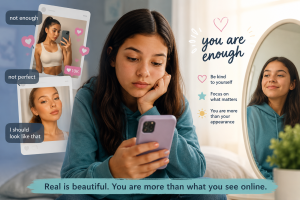
Up to 95% of teens are spending significant amounts of time on social media each day, exposure to these messages can become the normal. The desire for peer acceptance and the pressure to meet unrealistic beauty standards can make it difficult to develop a healthy self-image.
What many people forget is that social media does not show real life. Photos and videos are often edited, filtered, or altered with applications such as FaceTune. Today, another factor has entered the conversation: GLP-1 medications, such as Ozempic.
GLP-1 medications can help regulate appetite, slow digestion, and manage blood sugar levels. For some individuals, these medications are an important medical treatment prescribed by healthcare professionals. However, what teens often notice are the dramatic physical changes that can happen in a relatively short period of time, including weight loss and changes in facial appearance.
When celebrities or influencers share these transformations online, they may make the process appear simple or effortless. This can create unrealistic expectations for young people, who may begin comparing themselves to others and feeling dissatisfied with their own appearance. Constant comparison can negatively affect self-esteem, body image, and mental health.
It is important for teens to understand that while medication can be helpful for some people, it is not a quick fix for confidence or happiness. Lasting well-being comes from developing self-acceptance and caring for both your physical and emotional health.
Building confidence takes time and effort. Healthy habits that support personal growth include:
- Move your body in ways you enjoy. Physical activity can improve mood, reduce stress, and support overall health. Whether it’s sports, dancing, hiking, swimming, or simply taking a walk, find activities that make you feel good rather than focusing on burning calories or changing your appearance.
- Practice social and emotional self-care. Get enough sleep, manage stress, spend time with supportive friends and family, and make time for activities that help you relax and recharge.
- Celebrate personal growth. Instead of focusing only on how you look, pay attention to what you’re learning, creating, accomplishing, and overcoming. Your character, kindness, creativity, and resilience are just as important as your appearance.
- Set realistic goals. Healthy goals focus on feeling stronger, happier, or more confident rather than trying to achieve someone else’s body.
- Curate your social media feed. Consider unfollowing accounts that make you feel worse about yourself and following creators who promote body positivity, realistic lifestyles, education, or hobbies you enjoy.
- Remember that online content is often edited. Before comparing yourself to someone on social media, ask yourself: Is this really an accurate picture of everyday life?
Perhaps the most important thing to remember is that your value is never determined by your weight, clothing size, appearance, number of followers, or the amount of likes you receive online.
The qualities that truly define you—your compassion, honesty, humor, curiosity, determination, and the way you treat others—cannot be measured by a photograph or a social media post.
If you ever find yourself feeling overwhelmed by comparison, struggling with body image, or believing that your appearance determines your worth, know that you don’t have to handle those feelings alone. Talking with a trusted parent, teacher, school counselor, coach, or healthcare professional can help you gain perspective and find healthy ways to build confidence.
Social media will continue to evolve, and new trends will come and go. But one thing remains true: you are already enough. Your body is meant to grow and change throughout your life, and your worth has never depended on looking like someone else. The healthiest goal isn’t perfection—it’s learning to appreciate yourself for who you are.
Stat: up to 95% of youth ages 13-17 report using a social media platform, with more than a third saying they use social media “amost constantly.” https://www.ncbi.nlm.nih.gov/books/NBK594759/
Check out our Social Emotional Learning program, Navigating Middle School Years. This program has elements of how to behave online and how to spot inappropriate or dangerous behavior.
 Written By: Liz Garcia, Senior Health Educator

